Most flat tire repairs cost roughly $25 to $65. See what a proper repair includes, when a tire must be replaced, and what to do first in South Florida.
Flat Tire Repair Cost: What You’ll Pay and When It’s Fixable
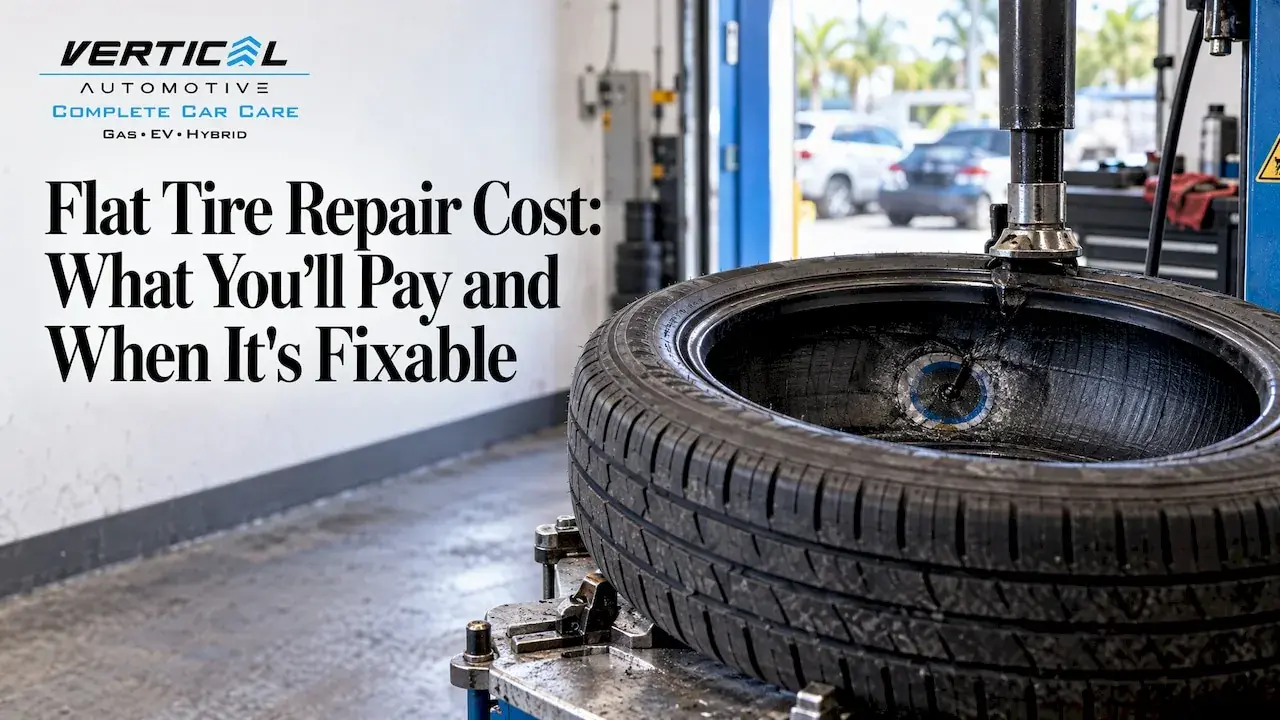
A proper flat tire repair usually costs between about $25 and $65 at a shop, and Kelley Blue Book puts the average at $54 to $64. That price only applies if the tire can be repaired at all. A puncture in the middle of the tread qualifies. Sidewall damage, or a tire that was driven flat, does not, and then you are paying for a new tire. This guide explains what drives the price, what a correct repair includes, and how to avoid turning a $40 problem into a $400 one. It is written for drivers in Fort Lauderdale, Wilton Manors and the surrounding area.
TL;DR
- A shop puncture repair typically runs about $25 to $65. A survey of 44 independent shop websites in October 2026 found a median posted price of $40.
- A tire can be repaired only if the hole is in the tread, no larger than 1/4 inch (6 mm), and the tire was not driven flat.
- A correct repair takes the tire off the wheel and uses a plug and an inside patch. A plug alone is only a temporary fix.
- Driving on a flat, even a short way, can ruin the tire and damage the wheel, so stop as soon as it is safe.
- Ask what the quote includes: balancing, valve stem, sensor reset, tax and any mobile or after-hours fee.
Table of Contents
- What a flat tire repair costs in the U.S.
- What a correct repair actually includes
- When a tire can be repaired and when it can’t
- Don’t drive on a flat to save time
- Questions to ask before you agree to a price
- Why a shop visit is the better value
- Have a flat tire in Fort Lauderdale or Wilton Manors?
- FAQ
- Sources
What a flat tire repair costs in the U.S.
Published figures vary because they come from different samples and different years. Here is what the checked sources say:
| Source | Reported figure |
|---|---|
| Kelley Blue Book | Average tire repair of $54 to $64, varying by vehicle and area |
| Survey of 44 independent shops, October 2026 | Median posted price of $40, middle half between $25 and $65 |
| Lemonade’s 2026 guide | Roughly $20 to $50 to repair, with a new tire running upwards of $100 |
The honest summary: expect something in the $25 to $65 range for a single puncture in a standard passenger tire, and expect the number to land toward the higher end in a busy urban market, for larger or low-profile tires, or when extras are added. These are national figures. Local pricing in South Florida depends on the shop’s labor rate and the vehicle.
Why the price moves
Labor is the part of the bill that changes most. The same October 2026 survey found that shops posting an hourly rate charge a median of $129 per hour, with a range from $100 to $165. A tire repair takes a fraction of an hour, but the shop’s rate sets how that fraction is priced.
Other things that raise or lower the total:
- Tire size and type. Large truck and SUV tires, low-profile performance tires and tires on wheels with pressure sensors take more care to remove and refit.
- Where the work happens. Driving to a shop is the lowest-cost route. Mobile service adds a dispatch or travel fee, which one price review found is commonly $50 to $150 on top of the repair.
- Add-ons. Balancing, a new valve stem, a tire pressure monitoring system (TPMS) reset and disposal fees can each be listed separately.
- Timing. Evenings, weekends and the days after a storm can cost more.
If you are comparing a “puncture repair price” quoted by phone, ask whether it is an all-in figure. A $20 headline that becomes $55 at the counter is not cheaper than a $45 price that includes everything.
What a correct repair actually includes
The cheapest fix is not always the right one. The Tire Industry Association says the only proper repair is to take the tire off the rim, inspect the inside, fill the injury, and seal the inner liner with a repair unit. A plug-only or patch-only repair is not acceptable, and a string plug put in from the outside while the tire stays on the wheel should be treated as temporary.
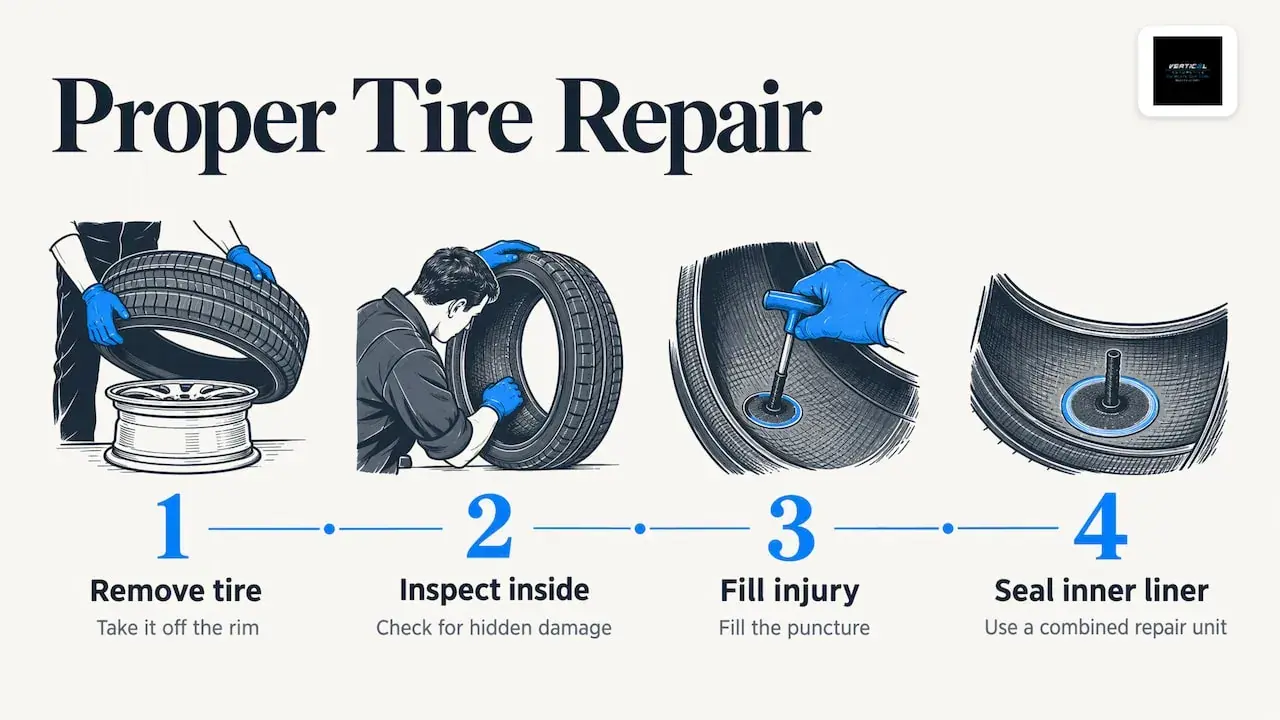
The tire association USTMA explains the reason: a plug alone leaves the inner liner unsealed and hides internal damage, so only a combined plug-and-patch repair with the tire off the wheel is a permanent one.
That matters for price. A plug done in a few minutes with the tire still on the car can cost less than a proper repair, but it does not buy the same result. When you compare quotes, you are comparing procedures as much as dollars.
The inside inspection is also the step that catches hidden harm. The Tire Industry Association notes that a nail in the tread can cause severe sidewall damage you cannot see from outside. Only a technician looking inside the tire can tell.
A typical visit, step by step
- Find the leak. The technician locates the puncture, often by checking the tire with soapy water or in a water tank.
- Remove the tire from the wheel. This lets the inside be inspected for cuts, bruising or other damage.
- Check the damage against repair limits. Location, size and any earlier repairs decide whether the tire can be saved.
- Fill and seal. The hole is filled and the inner liner is sealed with a repair unit.
- Refit, balance and check pressure. Balancing helps avoid vibration, and the TPMS light should be clear before you leave.
When a tire can be repaired and when it can’t
This is the question that decides your cost. USTMA says repair may be an option only when the damage is limited to the tread area and the puncture is no larger than 1/4 inch (6 mm). The tire must come off the wheel for inspection, and repairs cannot overlap.
The Tire Industry Association lists the cases that should not be repaired:
- Damage to the shoulder (the curved edge where the tread meets the sidewall) or the sidewall
- Injuries that overlap or sit directly opposite each other
- Punctures larger than 1/4 inch (6 mm)
- Tread worn down to 2/32 inch
All of these appear in the association’s tire repair guidance.
Sidewall damage is a replacement, always. The sidewall flexes with every rotation and carries load, so a patch there will not hold. Nobody can make that repair safe, however low the price.
A tire driven flat is usually done. A tire that has run flat for any distance can suffer internal damage that is not visible until it is taken apart. This is why the next section matters so much.
Worked example
Say you pick up a screw in the tread of a standard sedan tire on the way home. You notice the pressure warning, pull over and get to a shop with the tire still holding some air. The tread hole is small, the tire comes off, the inside looks clean, and it gets a plug-and-patch repair. At the survey median that is around $40. At the top of the typical range it is about $65.
Now say the same screw sits in the tread, but you drive another few miles on the flat because you are close to home. The sidewall collapses and gets chewed up. The tire is not repairable, and you are paying for a new one. One review of national prices describes a new tire as upwards of $100, and the real number depends on your size and model. If the wheel is scuffed or bent, the bill climbs more.
Don’t drive on a flat to save time
Unless your tire and vehicle are specifically designed for limited run-flat operation, the Tire Industry Association says continuing on a flat can quickly damage the tire and possibly the wheel. Kelley Blue Book advises driving on a flat only as far as it takes to get safely off the road and stop, because going farther risks the sidewall, the wheel rim and suspension parts, which cost far more than the flat itself.
Here is a practical routine:
- Tire still holds some air: Drive slowly and directly to a shop. Do not go on a longer errand first.
- Tire is fully flat: Stop in a safe place, turn on your hazards, and put on the spare or arrange for a tow. A compact spare is meant to get you to a repair shop, not to be driven on for weeks.
- You are on a highway shoulder: Safety comes first. If you cannot change the tire safely, call for roadside help.
Towing is a separate cost. If your auto policy includes roadside coverage, check it before you pay out of pocket. Insurance guides report that roadside assistance add-ons typically cost $6 to $15 per month and can include towing and flat tire changes, with mileage limits that vary by insurer.
Questions to ask before you agree to a price
A quick call can save you from a surprise. Ask:
- Will the tire come off the wheel for an inside inspection? A plug-and-patch repair needs it.
- Is balancing included?
- Is there a charge for a valve stem, a TPMS reset or disposal?
- Is tax included in the quoted figure?
- If the tire can’t be repaired, what does a replacement cost, and can you quote me before any work starts?
- Is the repair covered by a warranty?
That last question is where shops differ most. A repair is only as good as the work behind it.
Why a shop visit is the better value
A $15 plug kit or a quick roadside plug looks cheaper, but it does not include the inside inspection that decides whether the tire is safe. A technician who takes the tire off the wheel sees the damage you cannot, and tells you whether you are looking at a $40 repair or a replacement. You get that answer before you spend money on a repair that would not hold.
It also matters for the rest of the car. A tire that keeps losing pressure can mean uneven wear, a bent wheel or an alignment problem. Our tire care guide covers pressure and rotation, and alignment, rotation and balancing keeps a repaired tire wearing evenly.
South Florida adds its own conditions: hot pavement raises tire temperature, construction debris on I-95 and Federal Highway is a common source of nails and screws, and heavy rain hides hazards in standing water. Checking pressure monthly catches a slow leak before it becomes a flat.
Have a flat tire in Fort Lauderdale or Wilton Manors?
At Vertical Automotive we handle tire service and replacement at our Fort Lauderdale and Wilton Manors locations, with ASE-certified technicians and a 36-month/36,000-mile warranty on our services. We work on European, Asian, domestic, hybrid and electric vehicles, so a tire on a Tesla or a BMW gets the same attention as one on a pickup. Our digital vehicle inspections show you what the technician sees, so you know whether the tire is a repair or a replacement.

If you want to know what a replacement would cost before you commit, request a figure on our tire quotes page. For the repair itself, see our tire service and replacement page, or book through the auto repair page. Our team has serviced over 54,000 vehicles and holds a 4.9-star rating on Google.
FAQ
How much does it cost to repair a flat tire?
Most shop repairs fall between about $25 and $65. Kelley Blue Book reports an average of $54 to $64, and a survey of independent shops found a median of $40. Your price depends on the tire, the shop’s labor rate and what the quote includes.
Is it worth getting a tire patched?
Yes, when the damage is in the tread, the hole is no larger than 1/4 inch, and the tire was not driven flat. A proper plug-and-patch repair on a tire that qualifies costs far less than a new tire. If the damage is in the sidewall or shoulder, replacement is the only safe option.
Can I drive on a flat tire for 2 miles?
It is best not to. Driving on a flat can quickly damage the tire and possibly the wheel, and Kelley Blue Book advises driving only as far as needed to get safely off the road. Even a short distance can turn a repairable tire into a replacement. Use your spare or arrange a tow.
Is a plug as good as a patch?
A plug on its own is not a proper repair. USTMA says it leaves the inner liner unsealed and prevents inspection of the inside of the tire. A combined plug-and-patch repair with the tire off the wheel is the permanent method.
Does a mobile flat tire repair cost more?
Usually, because of the travel or dispatch fee. One review of mobile providers lists a $50 to $150 service fee on top of the repair when billed separately. Ask whether the quoted price is all-in.
Sources
- Tire Repair Costs | Kelley Blue Book
- Flat Tire Repair Cost: $25 to $65 at Independent Shops
- How Much Does It Cost to Repair a Tire?
- Mobile Tire Repair Cost: Real Provider Prices
- Tire Repair Basics | USTMA
- Tire Repair | Tire Industry Association
- Tire Questions | Tire Industry Association
- How Long Can You Drive on a Spare Tire? | Kelley Blue Book
- Roadside Assistance Coverage (2026 Insurance Guide)
Recommended
About the Author

Vertical Automotive
Editorial team