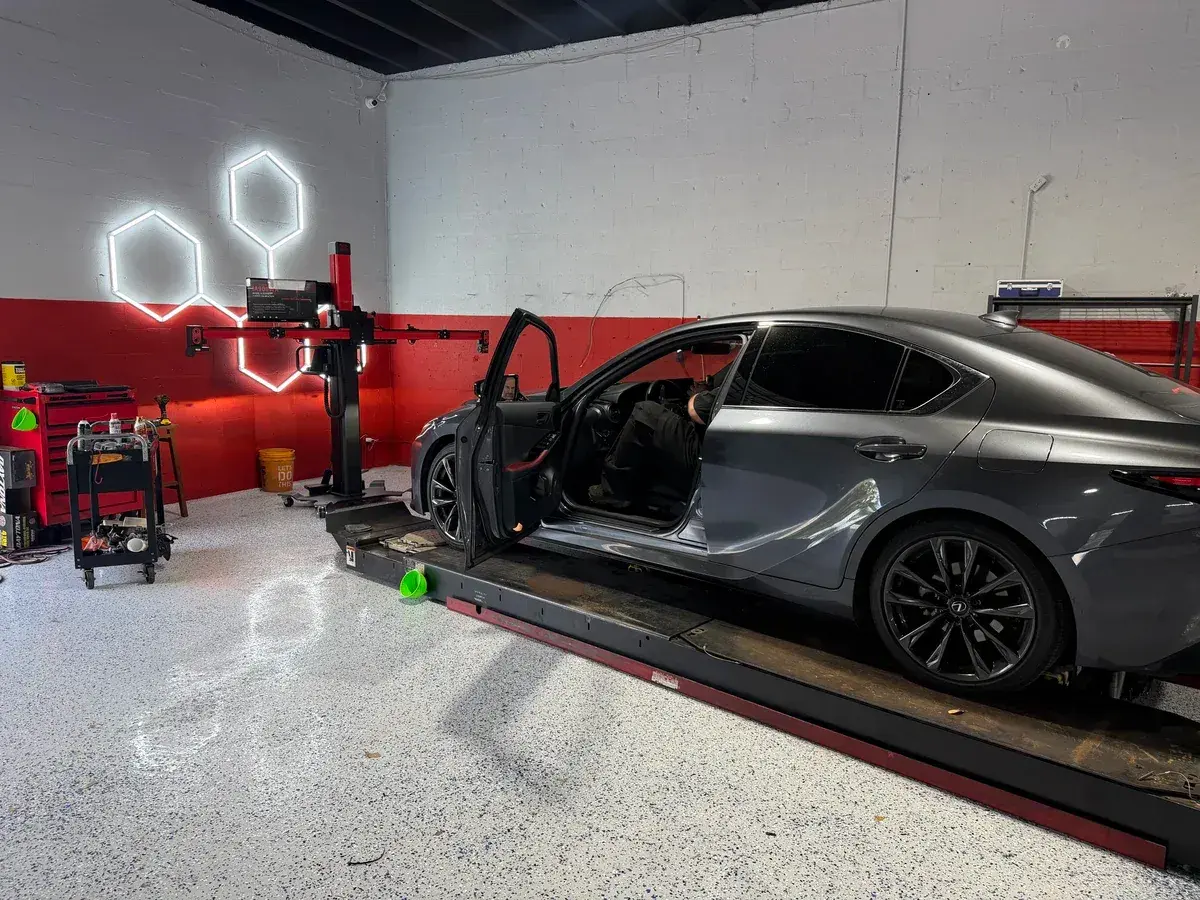
Wheel alignment in Fort Lauderdale explained: the warning signs, two-wheel vs. four-wheel, EV specifics, typical costs and what a good alignment visit includes.
Wheel Alignment in Fort Lauderdale: Signs, Cost and What to Expect

If your car pulls to one side, your steering wheel sits crooked, or your front tires are wearing on one edge, you need an alignment check. Book it with a shop that inspects the tires and suspension first and aligns all four wheels to factory specs. At Vertical Automotive, our Fort Lauderdale wheel alignment service covers alignment, tire rotation and balancing for European, Asian, domestic, hybrid and electric vehicles, backed by ASE-certified technicians and a 36-month/36,000-mile warranty.
This guide explains what alignment does, how to spot a problem early, what a proper visit looks like and what you can expect to pay in Broward County.
TL;DR
- Pulling, an off-center steering wheel, vibration or uneven tire wear are the classic signs your alignment is off.
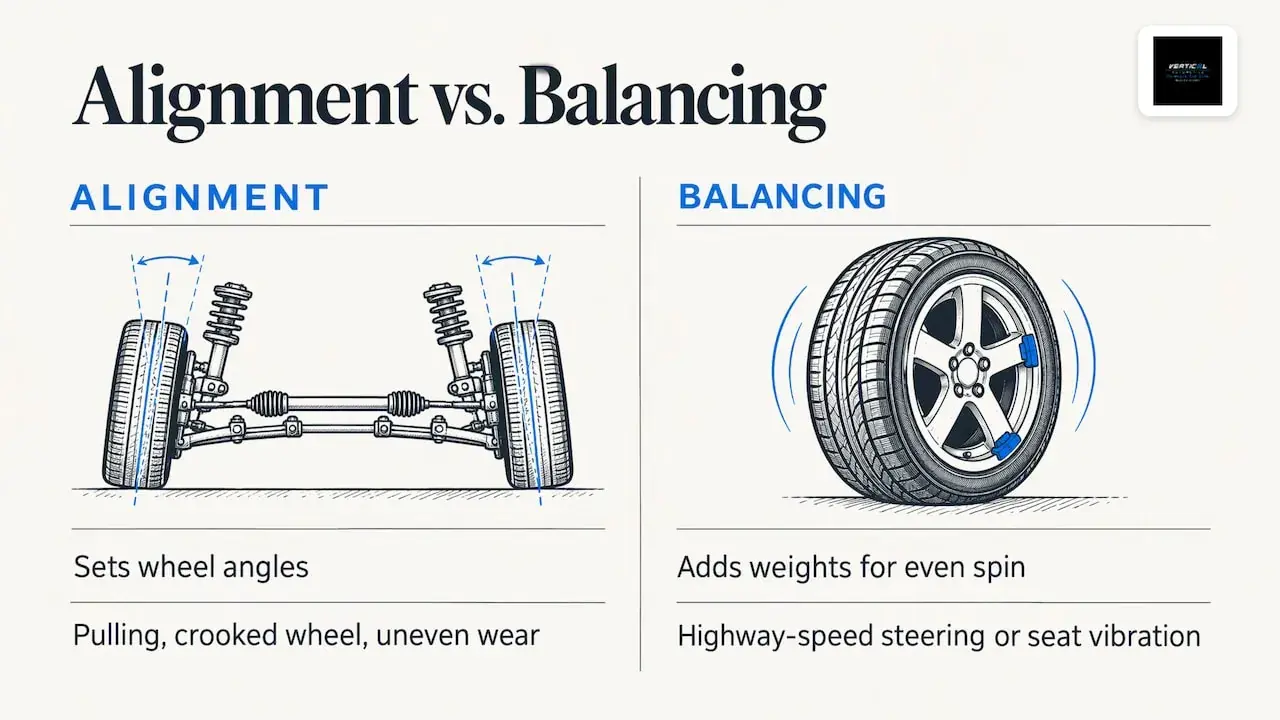
- Alignment points the wheels the right way. Balancing smooths how they spin. They are different jobs, and many visits need both.
- Ask for a four-wheel alignment unless your car’s maker says otherwise. Some makers, such as Nissan, call for it on every vehicle.
- Published estimates put a Florida alignment roughly between $50 and $150, depending on scope, vehicle and shop.
- Tesla and other EVs have their own procedures, so choose a shop that works on EVs every day.
Table of Contents
- What wheel alignment actually does
- Signs you need an alignment
- What happens during a proper alignment visit
- Two-wheel or four-wheel alignment?
- How often should you get an alignment checked?
- Electric vehicles and alignment
- What does a wheel alignment cost in Fort Lauderdale?
- Alignment at Vertical Automotive
- How to choose an alignment shop in Fort Lauderdale
- Quick tips to protect your alignment
- FAQ
- Sources
What wheel alignment actually does
Wheel alignment is the adjustment of your suspension so the wheels point in the direction the manufacturer designed, and meet the road at the right angle. It does not involve touching the tires themselves. Three angles matter most:
- Toe: whether the fronts of the tires point slightly inward or outward, like feet.
- Camber: whether the tire leans in or out when you look at the car from the front.
- Caster: the forward or backward tilt of the steering axis, which helps the steering wheel return to center and keeps the car tracking straight.
The goal is not to make everything perfectly straight. Factory specs often include small, deliberate offsets that suit the car’s drivetrain and suspension design. That is why a shop should align to your vehicle’s specific numbers, not to a general rule.
Alignment vs. tire balancing
People mix these up, and the confusion costs money. Alignment sets the angles of the wheels. Balancing adds small weights to the wheel and tire assembly so it spins evenly. An out-of-balance tire usually shows up as a vibration in the steering wheel or seat at highway speed. A misaligned car usually shows up as pulling, a crooked steering wheel or uneven wear. A car can have one problem without the other, which is why we list alignment, rotation and balancing together on one service page.
Signs you need an alignment
Misalignment rarely arrives with a warning light. It shows up in how the car feels and how the tires look. Check for these:
- The car pulls. On a flat, straight road, the car drifts left or right when you loosen your grip slightly.
- The steering wheel is off-center. You drive straight but the logo on the wheel is tilted.
- Uneven tire wear. Run your hand across the tread. Wear on just the inner or outer edge, or a saw-tooth feel (smooth in one direction, sharp in the other), points to camber or toe problems.
- Squealing tires in normal turns at low speed.
- Loose or wandering steering, where you make constant small corrections to stay in your lane.
- A recent impact. A hard hit on a pothole, a curb or a speed bump, or any collision, can knock the angles out in a single moment.
Vibration at a certain speed more often points to balance than alignment, but a technician should look at both. If you notice a mix of symptoms, an inspection is quicker and cheaper than guessing.
Why alignment goes out
Alignment drifts for ordinary reasons. Suspension parts wear over time. Bushings soften. Tie rod ends loosen. Add curbs, parking blocks, potholes and stop-and-go traffic, and the settings move away from spec gradually. Lowered vehicles, lifted trucks and cars with new wheels also need their angles reset. Nissan’s own technical guidance recommends alignment whenever a suspension component is replaced or disturbed, which is a good rule for any car: new control arms, struts or tie rods call for an alignment afterward.
That also means worn parts can be the real cause of a problem. If a shop adjusts the angles on a car with a worn ball joint, the numbers will not hold. This is why the inspection before the alignment matters as much as the alignment itself.
What happens during a proper alignment visit
A good alignment is a short process with a clear order. Here is what to expect, and where things commonly go wrong.
- Conversation and test drive. The technician should ask what you feel: pulling, vibration, noise. Your description tells them where to look.
- Tire and suspension inspection. Tire pressure, tread wear patterns, and the condition of steering and suspension parts are checked. Nissan’s guidance stresses that a shop should inspect the tires and understand the customer’s symptom first, since many complaints come from neglected inflation or rotation. Skipping this step is the most common way an alignment gets wasted.
- Replacement of worn parts, if needed. Loose or worn components are addressed before any adjustment. Our steering and suspension service covers this work in the same shop.
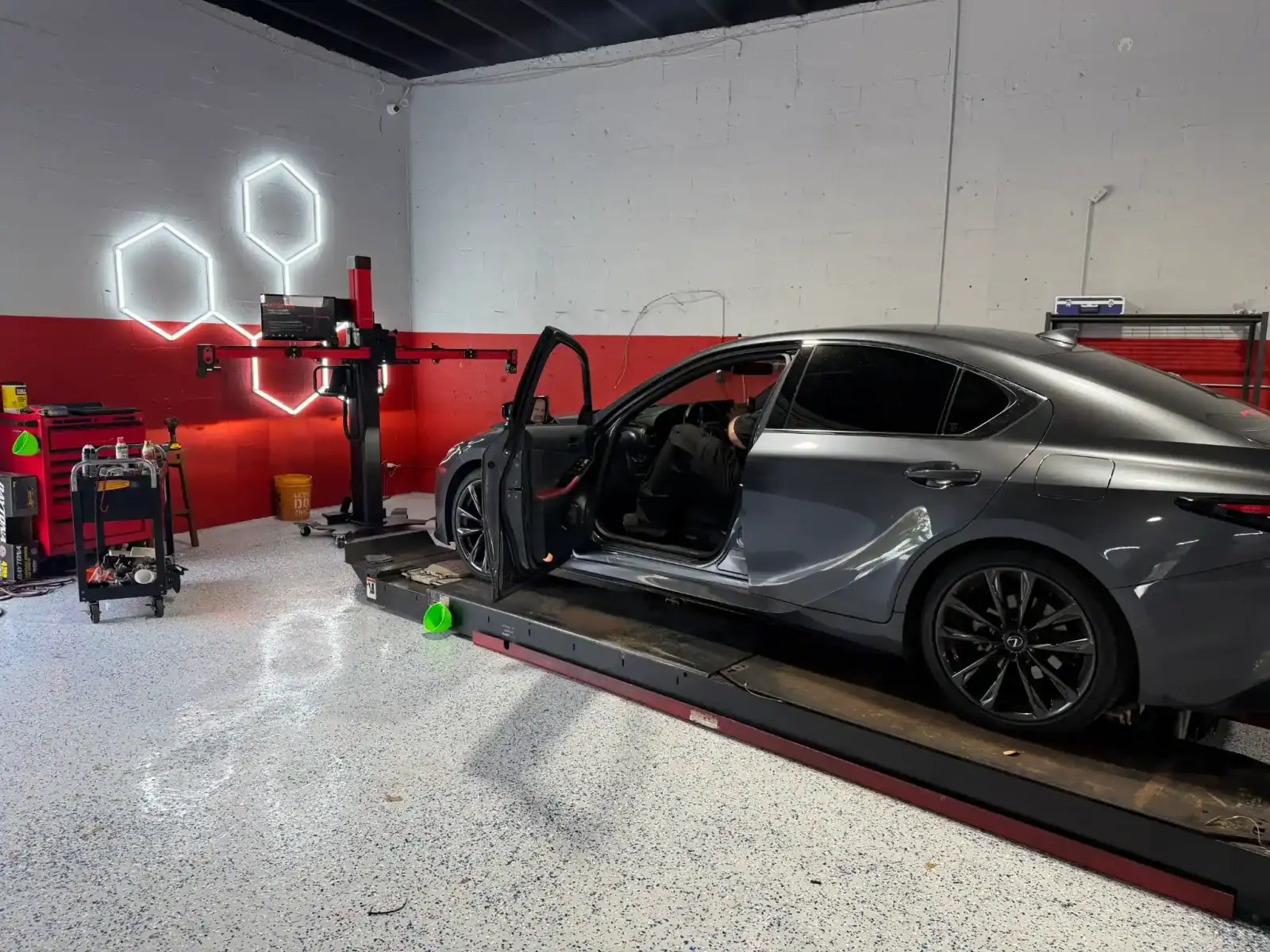
- Measurement on an alignment machine. Sensors read the current angles on each wheel and compare them to your vehicle’s factory specs.
- Adjustment. The technician adjusts toe, camber and caster where the vehicle allows, and centers the steering wheel.
- Final check and test drive. The car should track straight, the steering wheel should sit level, and the pulling should be gone.
Ask to see the before-and-after readings. You should be able to see which angles were out of spec and where they ended up. Tire wear evens out over the following weeks, so judge the result by how the car drives right away and by how the tires look over the next few thousand miles.
Two-wheel or four-wheel alignment?
A front-end (two-wheel) alignment adjusts only the front wheels. A four-wheel alignment measures all four and sets the rear angles too, so the car is aligned in relation to itself. Which one you need depends on the vehicle’s suspension and on what the maker specifies.
Here is the practical rule: a front-only adjustment can leave the front wheels pointed one way and the rear wheels another. Nissan’s guidance is a clear example. It recommends a four-wheel thrust alignment on all its vehicles, whether or not the rear end is adjustable, so that the car is aligned to its own centerline. Many modern cars with independent rear suspension are the same. When in doubt, a four-wheel alignment is the safer choice for tire life and straight tracking.
How often should you get an alignment checked?
There is no single mileage that fits every car, and Nissan does not publish a fixed preventive interval for its vehicles. Use these practical triggers instead:
- After new tires. A new set should start on correct angles, or you shorten its life from day one.
- After suspension or steering repair. Struts, control arms, tie rods and ball joints all change the geometry.
- After an impact. A pothole, curb strike or accident.
- When symptoms appear. Pulling, a crooked wheel or uneven wear.
- At a regular check. Many owners check once a year, or whenever they get a tire rotation, which is a convenient moment for a quick look at wear patterns.
South Florida drivers deal with heavy traffic, construction zones and tight parking, so a yearly look is a sensible habit. Rotating your tires regularly also makes uneven wear easier to catch, since the tech sees each tire in a new position.
Electric vehicles and alignment
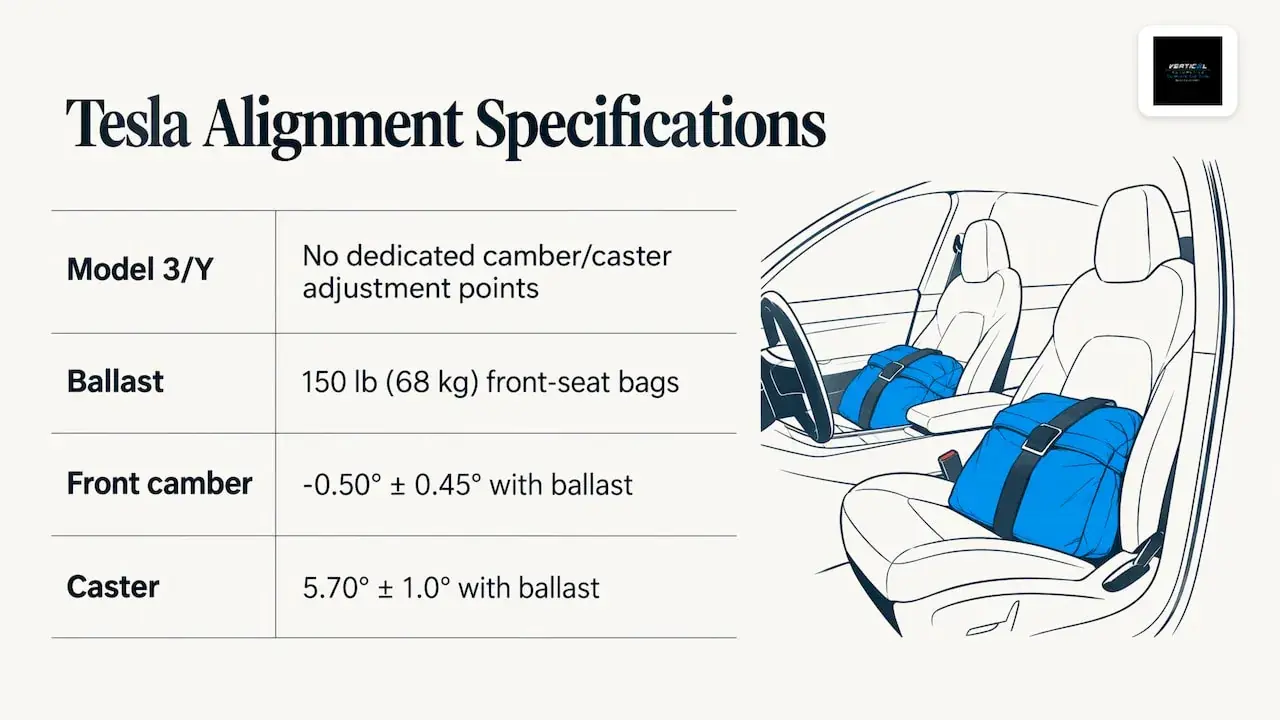
EV owners should pay particular attention here, because alignment on an EV is not always a standard job. Tesla’s U.S. service manual explains that Model 3 and Model Y have no dedicated adjustment points for camber and caster. They are adjusted by manipulating slack in the suspension, and the procedure calls for 150 lb (68 kg) ballast bags on the front seats to simulate occupants. Without that ballast, the real-world accuracy suffers. The manual lists specs with ballast, including front camber of -0.50° ± 0.45° and caster of 5.70° ± 1.0°.
What that means for you: an alignment done on a Tesla without following the maker’s method may look fine on the printout and still drive wrong. Hybrids and EVs are also heavier and more torquey than comparable gas cars, so tires on them reward careful setup. Our team handles hybrid and EV service every day, and we wrote a Tesla suspension and alignment guide for South Florida if you want the model-specific detail.
European cars have their own quirks too, from multi-link suspensions to tight factory tolerances. If you drive a BMW, Mercedes, Volvo, Audi or similar, our European car repair team works to those specs.
What does a wheel alignment cost in Fort Lauderdale?
Prices vary by shop, vehicle and scope, so treat any number as a range. Here are published estimates:
| Source and period | Estimate |
|---|---|
| Ecostify, March 2026, Miami, Fort Lauderdale and Pompano Beach metro | $70 to $150 budget, $110 to $210 mid-range, $210 to $240 premium |
| CostWhale, 2026 guide, Florida average | $98 average, with a $59 to $147 range |
| CostWhale, 2026 guide, by scope | $50 to $100 for two-wheel, $80 to $150 for four-wheel |
These are third-party estimates, so use them to sense the range, not as a quote. What moves the price:
- Scope. Four-wheel costs more than front-only.
- Vehicle. European, lifted, lowered, EV and performance vehicles may need more time or specialized equipment.
- Condition. Seized adjusters or worn parts add labor, and worn parts must be replaced before the angles can hold.
- Warranty. Some shops offer lifetime alignment packages that pay off if you keep the car a long time. Ask what is covered and for how long.
The cheapest alignment is not the cheapest outcome. A rushed adjustment that skips the inspection can leave you back at the shop in a month, or replacing tires early. Call us or book online for a quote on your specific vehicle.
Alignment at Vertical Automotive
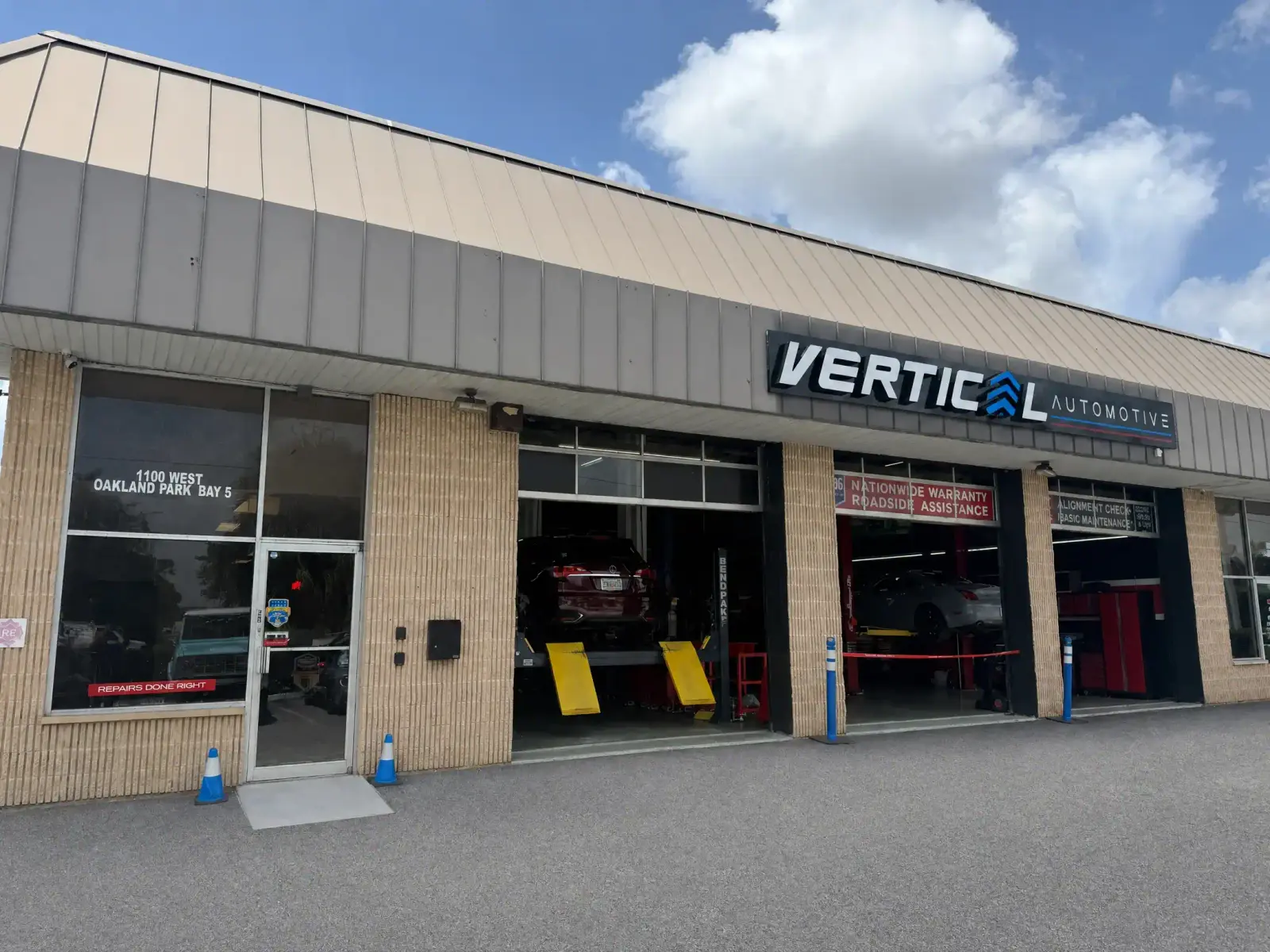
We do alignment, tire rotation and balancing at both of our locations, Fort Lauderdale and Wilton Manors, the latter at 1100 W Oakland Park Blvd, Unit 5. Our technicians are ASE certified, we use digital vehicle inspections so you can see what we see, and our repairs carry a 36-month/36,000-mile warranty. More than 54,000 vehicles have come through our shops, and we hold a 4.9-star rating on Google.
If your tires are worn enough that alignment alone will not fix the problem, we also sell and install tires, so you can handle both in one visit. If the cause is a worn suspension part, our steering and suspension team can handle the repair and the alignment together.

You can see our full list of services on our auto repair page, or start on the Fort Lauderdale alignment page to book.
How to choose an alignment shop in Fort Lauderdale
Whoever you pick, hold them to this checklist:
- They ask about symptoms and take a test drive or at least listen closely.
- They inspect tires and suspension first. Alignment on worn parts does not last.
- They align to your vehicle’s factory specs, and can tell you the numbers.
- They show before-and-after readings.
- They know your type of vehicle. A Tesla, a BMW and a lifted pickup are three different jobs.
- They stand behind the work with a clear written warranty.
That last point is where we put our weight: a 36-month/36,000-mile warranty on our repairs is meant to give you confidence you are not paying twice. A shop that treats tires, steering, suspension and alignment as one system will usually get better results than one that only runs cars across the alignment rack.
Quick tips to protect your alignment
- Check tire pressure monthly. Low pressure changes how the tire wears and hides real problems.
- Rotate tires on the schedule in your owner’s manual.
- Slow down for speed bumps and watch for potholes after heavy rain.
- Do not ignore a small pull. It gets more expensive the longer you drive on it.
- Book an alignment check after any new tires or suspension work.
FAQ
How long does a wheel alignment take?
The measuring and adjusting are usually a short job, but the inspection before it adds time, and worn parts add more. Plan on a visit rather than a quick stop, and ask your shop for an estimate when you book. If parts need replacing, the shop should tell you before starting.
Do I need an alignment when I buy new tires?
It is a smart time to check. New tires on out-of-spec angles can wear unevenly from the first few thousand miles, which wastes the money you just spent. If your old tires showed uneven wear, it is a strong sign the angles need attention before the new set goes on.
Can potholes really knock a car out of alignment?
Yes. A hard impact with a pothole or curb can shift suspension angles instantly. If you notice pulling, a crooked steering wheel or new vibration after a hit, have it inspected, since bent or damaged parts may be involved as well.
Does my Tesla or EV need a special alignment?
Often, yes. Tesla’s service manual specifies a procedure with weighted ballast on the front seats and adjusts camber and caster without dedicated adjusters on Model 3 and Model Y. Choose a shop with EV experience, like our hybrid and EV team.
Is alignment the same as balancing?
No. Alignment sets the direction and angle of the wheels. Balancing evens out the weight of the wheel and tire so it spins smoothly. Pulling and uneven wear point to alignment, while vibration at highway speed points to balance. We can check both in one visit.
Sources
- Keeping it Straightforward: Nissan Alignment Considerations
- Wheel Alignment, Tesla Model 3 Service Manual
- Wheel Alignment Cost in Miami, FL (2026 Prices), Ecostify
- How Much Does Wheel Alignment Cost? (2026 Guide), CostWhale
Recommended
About the Author

Vertical Automotive
Editorial team